Historic New London
After reading about and visiting the historic town of New London, I have a far greater realization of the work that it takes to preserve historic buildings and the large number of different people with different occupations that it requires. There are also different types of historic preservationists–passive, active, and professional (Tyler, 2018, 9). Historic preservation is indeed a communal endeavor.
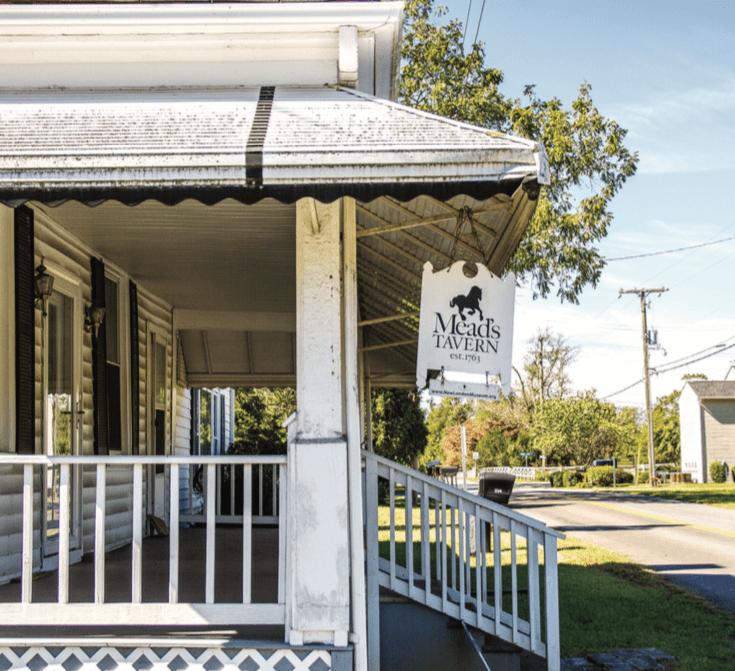
One of the things that I enjoyed most about New London was that there are structures from several different time periods all still standing. It is almost as if one can walk through two hundred and fifty years of the history of the town just by visiting all of the different buildings. For instance, Mead’s Tavern, the oldest standing structure in New London, and actually in the entire Lynchburg area, was built in 1763. The Bedford Alum Springs Hotel was built in the late 1910s, though there were previous buildings on the property throughout the late eighteenth and the nineteenth centuries, and the African American church was built in 1930. One can also see some of the different architectural styles of different time periods in the New London buildings.
One of the most important groups that has been involved in preservation at New London is the Friends of New London, chaired by Randy Lichtenberger. Friends of New London is a group of local residents that formed to attempt to preserve the incredible history of their town and its historic structures and to inform others about it. Since its formation in 2008, it has acquired many of the historic structures in New London, later selling Mead’s Tavern and the Bedford Alum Springs Hotel to Liberty University. They are also attempting to acquire other historic buildings that are still privately owned. Without the Friends of New London, none of the preservation that has gone on in New London would have been possible, and many of the historic structures would have been destroyed or lying in disrepair. For example, the African American Church was being destroyed when Friends of New London was able to acquire the property. Furthermore, most people would never have been able to learn about the great historic significance of New London, especially the fact that it once housed a federal arsenal used during the American Revolution, at least according to the Wikipedia page put together by Liberty history students (https://en.wikipedia.org/wiki/New_London,_Virginia).
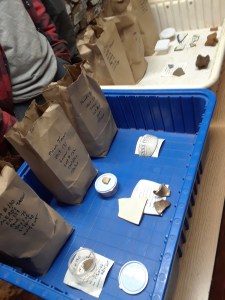
Another group of people vital to historic preservation is the archaeologists. According to the Mead’s Tavern Historical Structures Report, Liberty University hired archaeologists to excavate at Mead’s Tavern. Randy Lichtenberger is also very involved in the archaeology there. He has conducted substantial research on Mead’s Tavern and other buildings in New London. Incredible artifacts have been found. The archaeologists are also attempting to find the foundations of the arsenal and other buildings which are no longer standing.
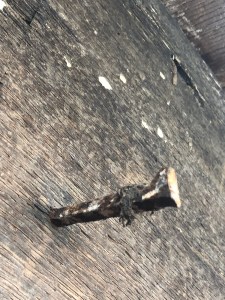
The third essential group of people is the architectural historians. At New London, Mr. Rakes, an architectural historian, and Mr. Pezzoni, a historical (or preservationist) architect, have done extensive research on the historic buildings, particularly Mead’s Tavern. They compiled the Mead’s Tavern Historic Structures Report (http://cdm17184.contentdm.oclc.org/cdm/compoundobject/collection/p17184coll2/id/154) and the Pezzoni Bedford Alum Springs Hotel Preliminary Report (http://cdm17184.contentdm.oclc.org/cdm/singleitem/collection/p17184coll2/id/155). They have been able to identify not only which portions were built in which era, but also the materials used, down to the nails and some of the paint.
Historic preservation teaches you to work well with others. It also, in a way, makes the past come alive and be available to the public by allowing people to actually be where historical figures were and experience what they did. William Murtagh said that “Preservation engages the past in a conversation with the present over a mutual concern for the future” (Tyler 2018, 95). The work done by historic preservationists should never be taken for granted.
Tyler, Norman, Ilene R. Tyler, and Ted J. Ligibel. Historic Preservation: An Introduction to its History, Principles, and Practice. New York, NY: W.W. Norton and Company, Inc., 2018.
 Haley Fury