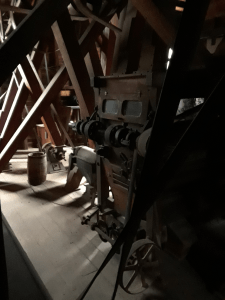
The Thompson Mill complex sits on more than six acres in Amherst County, Virginia. There are several buildings on the property, including a mill, two houses, a barn, an ice house, and several smaller buildings. The complex was nominated for the National Register of Historic Properties and was listed as a historic property in 2019. Perhaps my favorite aspect of the property was all of the machinery still contained within the mill, which will be left intact even after the mill has been rehabilitated.
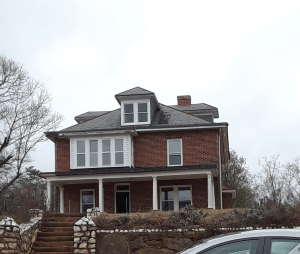
This property is a great example of the rehabilitation treatment. Rehabilitation is the process of adapting a historic structure to be used in some other way than it was originally used while still maintaining its historical integrity. In this instance, the mill itself is being converted into a restaurant and brewery, the main house will become a bed and breakfast, the ice house will be rented out for weddings and other gatherings, and the smaller house on the property will be occupied by the person in charge of the farm. On the farm, they will be growing almost all of their own ingredients for their food and beer. Yet all of the buildings will be kept in their original state as far as is possible.
This property is also an illustration of the several different kinds of people that it takes to restore a historic property. The owner, other preservationists, and even the construction workers all have a part to play. Furthermore, the owner was required to work with the local and state governments and even the road services to make necessary changes to the building. Historic preservation takes people from many very different walks of life.
Furthermore, historic preservation in general, and rehabilitation in particular, are in themselves forms of public history. Many people who would not study history on their own will visit a place that will actually connect them with the past. In these areas, they are able to experience for themselves what life would have been like at a certain place long ago. Furthermore, even people who would not visit a historic site as such will go to places like restaurants or breweries. Thus, they are learning and perhaps even becoming interested in history through these rehabilitated structures. Also, the area or town that the historic structure is located in, in this case Amherst, Virginia, will be positively affected by the tourism.
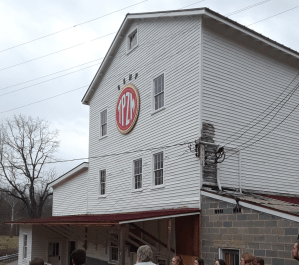
Although the mill is considered vernacular architecture, it still shows elements of design.1 While it is not a flawless example of a particular type of style, nor was it built by a famous architect, it still holds historical value. It tells the story of those who built it, who worked there, the type of work that was done there, and thus of the culture that it was in. Vernacular buildings can often tell us as much or more about culture and society than can stylized buildings simply because ordinary people typically lived and worked in vernacular structures.
Historic structures, even those that may seem to be simply boring, everyday buildings, have much to teach us about the past. Buildings are, as far as possible, an “unmediated record” of history.2 From them, we can learn about the lives of everyday people who were humans just like we are, who faced hardships and experienced the same emotions and thoughts that we do. Historic structures have the ability to connect us with those who have gone before us.
1 Carter, Thomas, and Elizabeth Collins Cromley. Vernacular Architecture: A Guide to the Study of Ordinary Buildings and Landscapes. (Knoxville, TN: University of Tennessee Press, 2005), 13.
2 Ibid., 65.
 Haley Fury