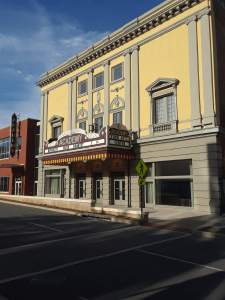
The historic Academy Theatre in downtown Lynchburg is an incredible example not only of historic preservation, but also of a community coming together to preserve a part of their history. The building was originally built in 1905, but after its closure in 1958 it fell into disrepair. According to an article entitled “Restoration of the Historic Theatre” on the Academy of Fine Arts’ website, “The theatre’s interior…is now a grim reminder of what happens when these sensitive surfaces are exposed to extreme shifts in temperature and humidity. Even the smallest holes in a roof over decades can reduce dreams to dust.”1 However, after being restored, the theatre is a magnificent, functioning structure. Downtown Lynchburg contains many other restored historic structures as well.

The theatre displays all four of the treatments outlined by the National Park Service: preservation, rehabilitation, restoration, and reconstruction. Preservation can be seen in certain portions of the roof and in some of the outer brick that has been kept. Reconstruction can be seen in the rebuilt fly towers, which had fallen before restoration work had begun, and restoration can be seen in all of the artwork and sculpture that graces the inside of the theatre. Finally, the structure has been rehabilitated to be a functioning theatre once again, complete with modern safety and accessibility features. Very rarely does one find all four treatments displayed in one structure. Furthermore, the many historic structures that downtown Lynchburg holds have primarily been restored and then rehabilitated as businesses, including restaurants and hotels.
The Academy Theatre holds great historical significance as well. In its early days, it hosted several famous and important people, including people such as Billie Burke, who played Glinda the Good Witch in the Wizard of Oz. It was later converted into a movie theatre, playing films through the age of silent movies, the advent of “talkies”, and most of the golden age of Hollywood. In addition, the theatre is an example of the Jim Crow era in the South, remaining segregated until it closed in 1958. The first integrated performance in the theatre was not performed until after the reopening of the Academy Theatre in 2018.
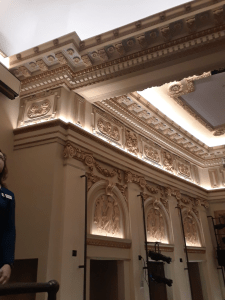
Finally, the Academy Theatre has a special place in the community. Beside the historical significance to the community, as talked about in the paragraph above, the Academy Theatre has the ability to bring people together, and not just through integration. People can connect over the history of their community, as well as over the performance of the arts. Any structure that has historical significance to a community can often draw together people of different occupations and backgrounds by uniting them in a common interest over a shared past.
Historic preservation is not simply restoring old buildings, as can be seen from the restoration of the Academy Theatre. Although that is a part of it, historic preservation also has the ability to give people a deeper appreciation of history. Further, it can bring all different sorts of people together, especially when the structure that is being restored is part of the history of a community. Historic preservation takes all kinds, not just historians and architects. It is truly a communal endeavor.
1 Art Lover. “Restoration of the Historic Theatre.” Academy of Fine Art. Accessed March 27, 2020. http://www.academyfinearts.com/restoration-project/.
 Haley Fury