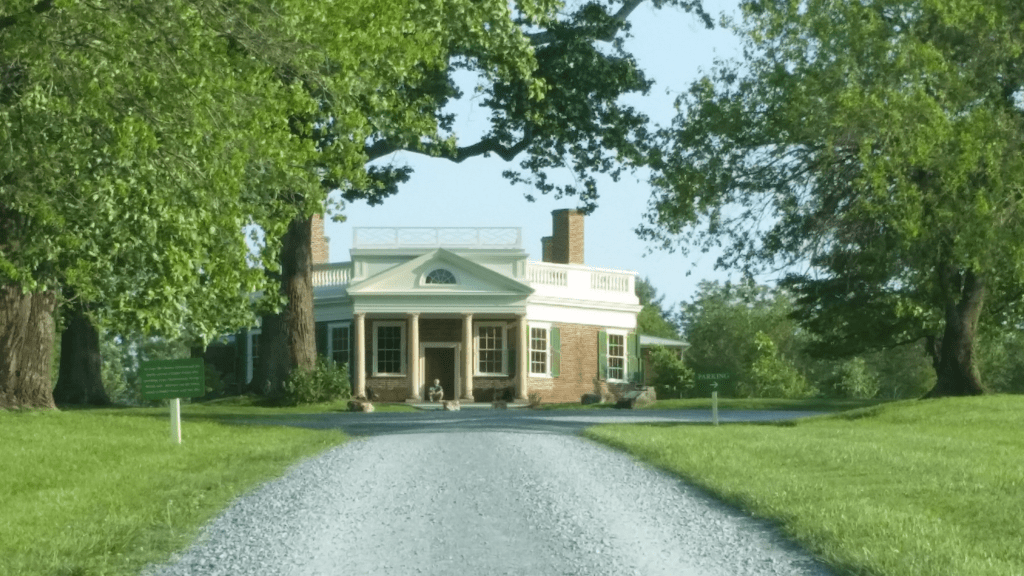
Poplar Forest served as the private retreat home of Thomas Jefferson. Though not as well known as Monticello, Poplar Forest was also designed by Jefferson himself. The estate perhaps reveals more about the man than does Monticello, due to the fact that Jefferson designed it solely for himself and his family and could thus include any features that he wanted. The process of building the house was begun during Jefferson’s presidency and was never entirely completed during Jefferson’s lifetime, though Jefferson did live there intermittently for a few years prior to his death. Poplar Forest changed hands several times and underwent many architectural changes before the process of restoration was begun. Now, it serves as one of the best examples of historic restoration in the United States.
All four of the treatments were used in some way at the Poplar Forest site. The house itself, however, was restored to the time of Jefferson. The landscape is being reconstructed to the same time period. Historic preservationists who have been working at the site have given great attention to detail and historical accuracy. For instance, when they needed bricks for reconstructive work, they made them from the same materials using the same methods that would have originally been used.When they restored the trim inside of the house, they hand-carved it using antique or replicas of antique tools that would have been used to originally make it. The Poplar Forest website states, “Details and materials, such as lumber, glass, lead, hardware, bricks, mortar, paint and finishes are carefully researched for site specific correctness and executed with accurate historical precision…”1 The importance that has been placed on historical accuracy at Poplar Forest is a model for all historic preservationists to follow.
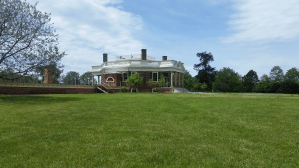
Perhaps one of the greatest challenges to restoring the site was the landscaping. Archaeologists conducted extensive research and work to discover where plants may have been and what kind were planted where. This process reveals the importance of historical research for historic preservation. Fortunately, Thomas Jefferson left very detailed records of everything that he planted. However, there were still crucial details missing. The archaeologists and historic preservationists looked to landscaping styles of the time period, other projects that Jefferson had done, their archaeological finds, and even geometry and surveyor’s measurements to discover the answers. Without this research, they would never have been able to accurately reconstruct the landscape. Historic preservation cannot be done without first conducting research.
The restoration work at Poplar Forest can be used as an example of what should be done during a preservation or restoration project. It demonstrates the necessity of historical research for historic preservation. Travis McDonald states, “The quality and success of any restoration project is founded upon the initial research.”2 Furthermore, it teaches preservationists to pay attention to detail and provides a model of historical accuracy for them to follow. Maintaining the historical integrity of a site is one of the most important criteria for the preservationist. The dedication and commitment to excellence displayed by preservationists at Poplar Forest serves as an example not only for all historic preservationists and archaeologists, but for all people in every walk of life.
1 “Materials and Techniques.” Architectural Restoration. Poplar Forest Website. Accessed April 16, 2020. https://www.poplarforest.org/learn/architectural-restoration/materials-techniques/.
2 Mcdonald, Jr., Travis C. “Understanding Old Buildings: The Process of Architectural Investigation.” National Park Service Preservation Brief #35.
 Haley Fury